Internal pipe bending of pre-insulated steel pipes
Bendforce GmbH has developed an industrial technology that enables steel pipes manufactured in accordance with EN 253—including both pre-insulated plastic-jacketed pipes and uninsulated steel pipes—to be cold-bent from the inside with a bending radius of up to 40 × D.
The patented process enables the precise production of pipe bends without the application of heat, while ensuring high dimensional accuracy and low ovality. A wide variety of steel grades, including high-strength steels, as well as pipes with thick walls, can be reliably processed. The technology is designed for pipe lengths of up to 18 meters, thereby opening up additional international opportunities for the planning and implementation of sophisticated pipeline routes in accordance with current standards (API5L, DVGW-G 463, ASME B16.49).
A key advantage of our technology is its mobility and global deployability. The bending systems for DN200 to DN400 are fully integrated into a vehicle trailer, while the systems for DN450 to DN1000 are housed in a 20-foot ocean-going container with CSC certification. This allows all bending systems to be transported flexibly and quickly to the construction site, where the pipes can be bent directly on-site. This significantly reduces the transportation and logistical costs for the pipes in some cases and, at the same time, enables a rapid response to changes in actual conditions at the construction site.
Compared to conventional methods, our technology reduces the need for welded fittings and allows for longer pipe sections with fewer welds. This simplifies both route planning and installation on the construction site, while also reducing installation times and costs.
The technology is suitable for demanding piping systems in the fields of district heating, oil, gas, and hydrogen pipeline construction. The ability to bend SIS pipes (steel-in-steel) also opens the door to applications in other industrial sectors. The combination of a wide range of dimensions from DN200 to DN1000, thick wall thicknesses, a wide variety of steel grades, pipe lengths of up to 18 meters, and mobile bending systems that can be used directly on the construction site enables their use in piping projects worldwide.
Why bend pipes from the inside?
- No external clamping or bending tools on the pipe: The forces are applied from the inside. This prevents damage to coatings, insulation, and the outer casing. No additional mandrel is required inside the pipe.
- Large dimensions and challenging wall thicknesses: The process is suitable for large pipe diameters and demanding wall thicknesses, as well as a wide variety of steel grades. Internal pipe bending technology now offers significant advantages, particularly when the diameter-to-wall-thickness ratio is unfavorable.
- Small bend radii and high precision: Bendforce bends the bend radii commonly used in pipeline construction—40xD—with low ovality and high angular accuracy. As a result, internal pipe bending technology represents a high-quality alternative to conventional external bending techniques.
- Fewer fittings: Many changes in direction can be bent directly into the pipe. This reduces the need for prefabricated elbows and special fittings. In some cases, the use of traditional U-expansion joints or other compensators can be completely eliminated.
- Fewer welds: A single bent pipe can replace several miter cuts, depending on its dimensions. This reduces welding work, testing requirements, and potential weak points, thereby increasing operational safety while lowering costs. From a structural standpoint, the use of bent pipe generally has a positive effect, as it reduces stress peaks.
- Complex Geometries: In addition to simple horizontal or vertical bends, S-bends, double bends, and three-dimensional bend patterns can also be created within a pipe. Culverts can thus be partially constructed on a single pipe section.
- Bending directly on the job site: Thanks to mobile systems ranging from DN200 to DN1000, the bending process can take place directly at the project site.
- Greater flexibility in route planning: The pipe geometry can be specifically adapted to the actual course of the trench. This is particularly advantageous in cases of elevation changes, obstacles, and last-minute changes on the construction site. The bent pipes can be manufactured directly from the open trench based on survey data.
- Time and cost savings: Fewer fittings, welds, transport trips, and rework can shorten construction time and reduce the overall cost of the piping system.
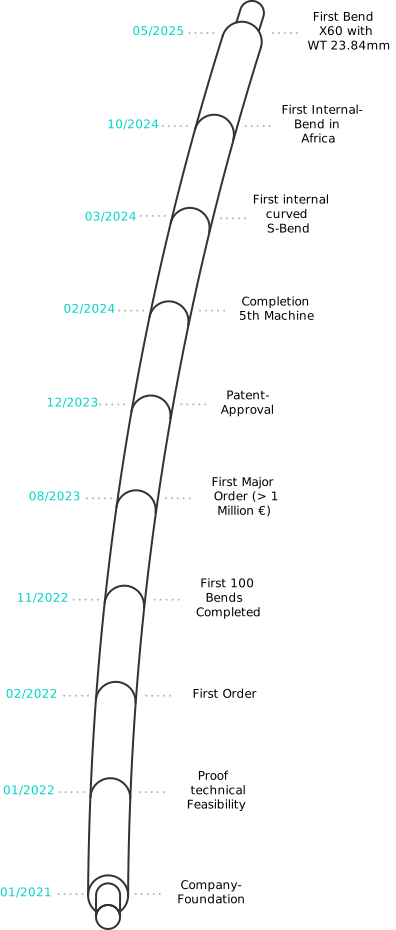
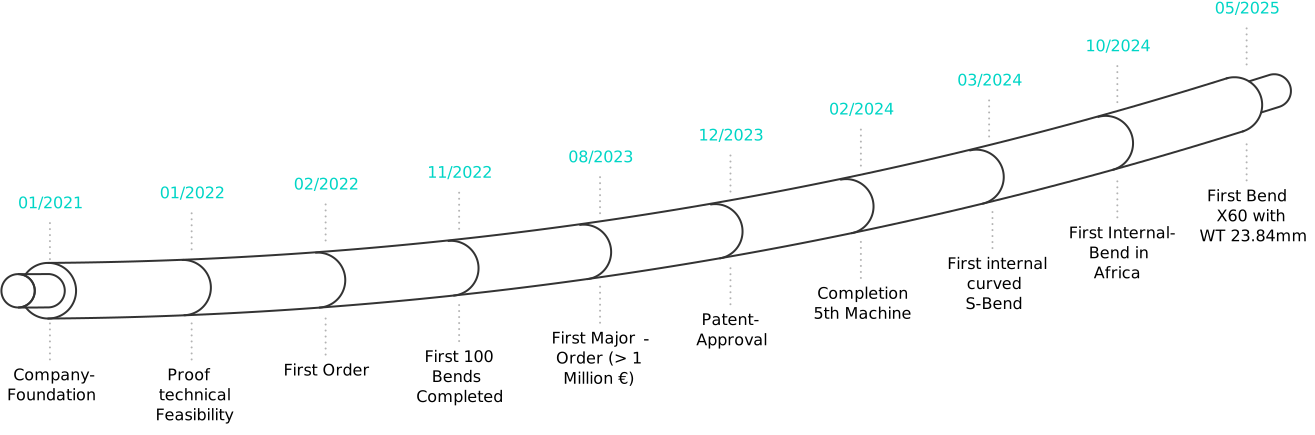
Milestones